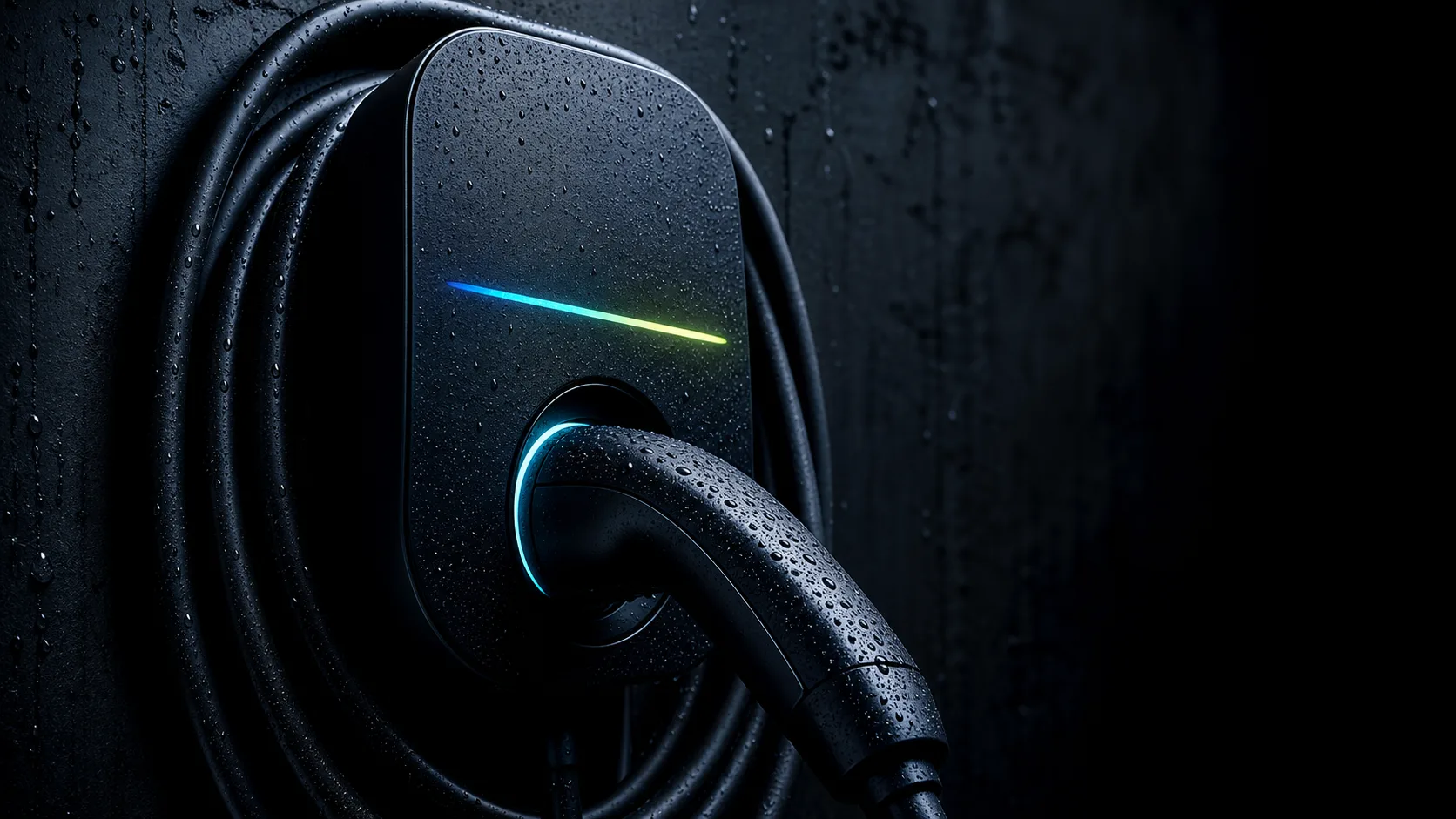
The charger unit is the fixed part — your cable run, consumer unit and earthing are what move the price. A short run on a modern board is the cheap end; a long run with a fuse-box upgrade is the expensive end.
When you read that a home EV charger "costs from £999", that is the easy bit. The unit and a clean, simple fit are roughly fixed in price. What actually moves your final quote — sometimes by hundreds of pounds — is everything between your fuse box and the spot where the charger goes. This guide walks through each variable, in rough order of how much it tends to swing the bill, so a higher-than-average quote stops feeling like a mystery.
For context, the live UK average for a standard 7kW home install on our cost index currently sits at £1,075, with real tracked installs ranging from roughly £775 at the simple end to about £1,400 at the involved end. That spread is the whole story: same charger, very different jobs. If you want a number for your own property rather than a national average, the installation cost page lets you compare real provider prices side by side.
1. Cable run length — the single biggest swing factor
The cable run is the distance the installer has to route armoured cable from your consumer unit (the fuse box) to the charger position. A garage right beside the fuse box might need three or four metres; a charger at the far end of a detached property can need twenty-five or more. Cable, clips, conduit and — above all — labour all scale with that distance, so a long run is usually the difference between a quote at the bottom of the band and one near the top.
Most fixed-price installs include a standard run, commonly the first 10–15 metres, then charge per extra metre beyond that. Two things push the figure up further: the cable having to go up and over (round door frames, along soffits, up to first-floor level) rather than straight across, and whether any of it has to be buried. A clipped surface run along a wall is quick; a buried run across a driveway means digging, which moves you into groundworks territory (see below). When you request quotes, telling the installer exactly where the charger should go and where your fuse box is will produce a far more accurate price than a generic estimate.
2. Consumer unit and electrical upgrades
Your charger has to connect to a circuit that meets current wiring regulations, including the right RCD protection. If your consumer unit is modern and has a spare way, this is straightforward and adds little. If it is an older board — or it is full — the installer may need to fit a separate enclosure with its own protective device, or recommend upgrading the consumer unit entirely. A board upgrade is one of the most common reasons a quote comes back higher than the headline price.
A related check is your main fuse and supply capacity. Many UK homes have an 80A or 100A main fuse, which comfortably handles a 7kW charger alongside normal household load, especially with the load-balancing now built into smart chargers. Occasionally an older property has a 60A or 63A supply, in which case the installer arranges a fuse upgrade with your network operator (the DNO) — usually free or low-cost, but it adds a step. None of this is a reason to panic; it is routine, and a good installer flags it up front rather than as a surprise on the day.
3. Earthing and protection arrangements
Outdoor charging points have specific earthing requirements. Historically a PME (protective multiple earthing) supply needed an additional earth rod for an outdoor charger, which meant extra labour and materials. Most modern smart chargers now have built-in open-PEN protection that satisfies the regulations without a separate earth rod, which has quietly removed a cost that used to appear on a lot of quotes.
Where it still bites is on older properties, unusual supply arrangements, or units that don't have that protection built in. If an earth rod is needed, it adds modest labour. It is worth confirming with the installer whether your chosen charger handles open-PEN protection internally — if it does, this line item usually disappears.
4. Groundworks, trenching and access
This is the wildcard. If the charger needs to sit on a post in the middle of a driveway, or the only sensible cable route crosses a path or lawn, you are into groundworks — lifting paving, digging a trench, ducting the cable and reinstating the surface. Trenching is labour-heavy and can add a meaningful amount on its own, which is why a quote involving it can sit at the top of, or above, the typical band.
Access and height matter too. A charger that has to go above a garage door, on a high wall, or anywhere a ladder won't safely reach can mean scaffolding or a tower, which is a cost line in its own right. Parking and access for the installer's van, and whether the work area is clear, also feed into the labour estimate. None of these apply to most installs — but when they do, they explain a quote that looks high against the average.
5. Charger choice, smart features and bundles
The unit itself is the part you control most. Real tracked charger prices in the UK currently run from roughly £775 to £1,400 across popular brands, and that range reflects features as much as badge: tethered (cable attached) versus untethered, the quality of the app, and how well it integrates with cheap overnight energy tariffs. A premium smart unit costs more up front but can pay back through smarter, cheaper charging — see our home charger comparison if you're still choosing.
Energy providers also sell the charger and install as a bundle. As market context, independent comparison sources have put typical UK home installs around £1,000 (Checkatrade), with one widely-cited forum floor around £999 (Reddit) and provider pricing such as E.ON from £1,272 — figures we cite as attributed market reference points, not as our own quotes. On our own data, the lowest tracked provider "from" prices we list are Pod Point from £999 and Octopus from £1,029; British Gas, E.ON and OVO are shown as "Not available" until we have a verified figure. The honest takeaway: a bundle can be good value, but compare the all-in number against an independent quote and the live average before committing. Our piece on whether Octopus really installs for free goes deeper on that.
6. The grant — what it takes off, and who gets it
If you're eligible, the EV chargepoint grant comes straight off your installer's invoice rather than being something you claim back later, and it materially lowers the net figure. As attributed market context, hardware-plus-install deals advertised from around £449.99 with the grant applied have appeared, and a typical net cost after grant of roughly £500 is a figure widely quoted in the market — again, reference points rather than our own pricing.
The catch is eligibility. From 2026 the grant is aimed at renters and flat owners (and on-street provision schemes), not driveway-owning homeowners, and you must use an OZEV-approved installer. If that's you, factor it in early — it can be the largest single reduction on the whole quote. Check where you stand with our grant checker.
Putting it together: reading your quote
A quote at the lower end — close to that ~£775 floor — usually means a short, surface cable run, a modern consumer unit with a spare way, no groundworks and a charger with built-in protection. A quote near or above the £1,400 top end usually reflects some combination of a long or buried run, a board or fuse upgrade, an earth rod, trenching or access work. Neither is "wrong" — they're different jobs.
Before you accept anything, ask the installer to itemise: cable run length and route, whether a consumer-unit or fuse upgrade is included, earthing arrangement, and any groundworks or access charges. That turns a single intimidating number into a checklist you can compare like-for-like. To sanity-check the bottom line against real UK data, run your details through the cost comparison tool and cross-reference the live cost index. Updated June 2026.