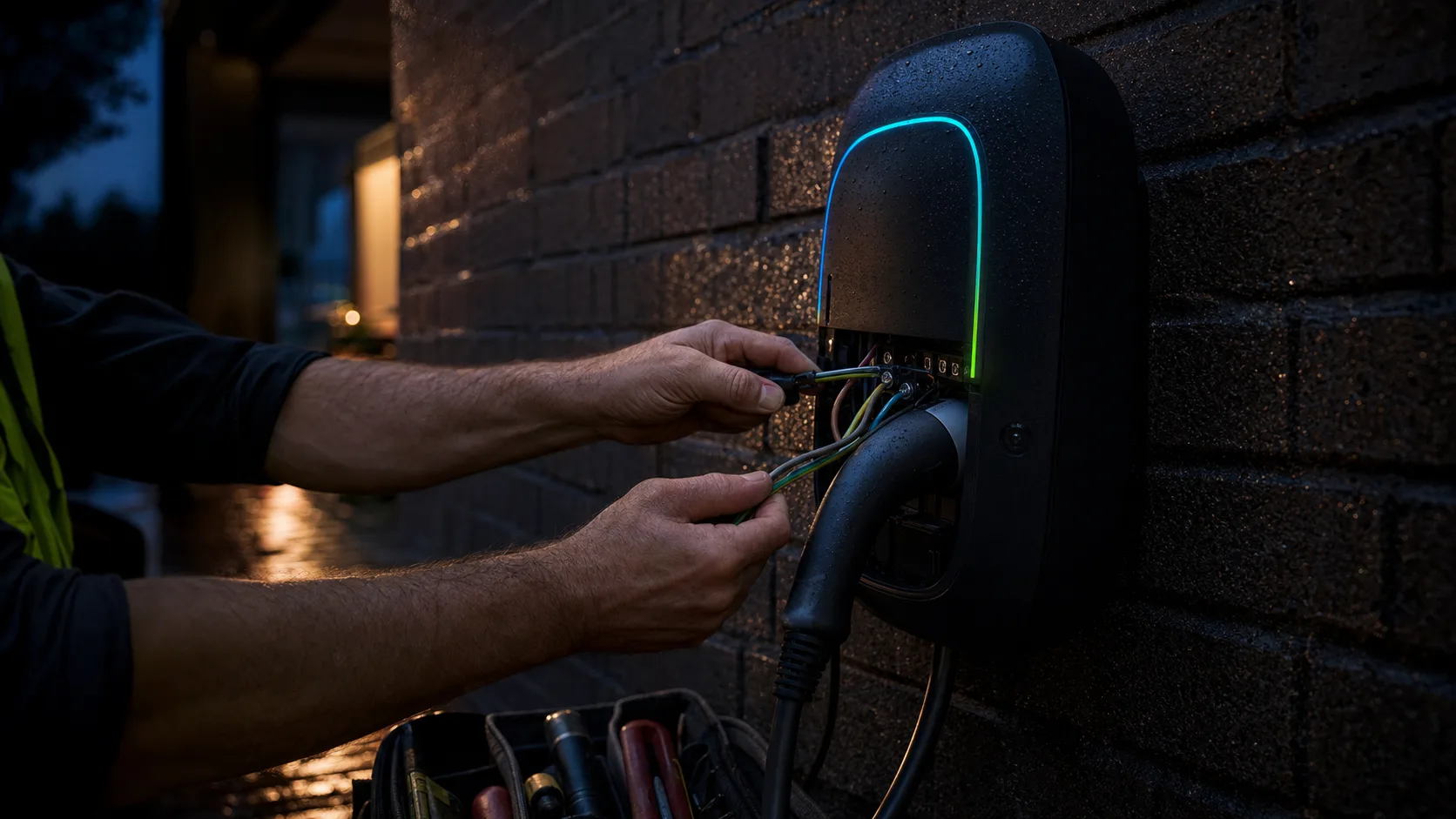
There is no separate Welsh Government grant for home EV chargers. Households in Wales claim the UK-wide chargepoint grant of up to £500 per socket. Welsh Government funding exists, but it targets public charging, social housing and businesses rather than private home installs.
If you've been searching for a Welsh EV charger grant and coming away confused, there's a straightforward reason: a distinct Welsh home charger grant doesn't exist. Plenty of pages are written as though it does, usually by blending the UK-wide scheme with Welsh Government infrastructure funding that has nothing to do with private homes.
This guide is deliberately blunt about that, because the practical consequence matters. If you budget for a mythical Welsh top-up on your home install, you'll be short. Here's what you can genuinely claim in Wales, and where the Welsh money actually goes.
What you can claim: the UK-wide £500 grant
The EV chargepoint grant applies in Wales exactly as it does in England and Scotland. It's worth up to £500 per chargepoint socket, having increased from £350 on 1 April 2026, with the higher rate confirmed through to March 2027.
You're eligible if you're a renter, a flat owner, a residential landlord, a household using on-street parking, or a business. Owner-occupiers of houses with a private driveway are excluded — that's a scheme-wide rule, not a Welsh quirk.
As elsewhere, the money never passes through your hands. An OZEV-approved installer claims it and deducts it from your invoice, so you pay the reduced balance. Our eligibility guide covers the full criteria and the paperwork you'll need.
Where Welsh Government money actually goes
Welsh Government EV funding is real and substantial — it's simply aimed at infrastructure and specific groups rather than individual homeowners:
Social housing EV charging. Funding for housing associations to install chargepoints across social housing in Wales. If you're a social tenant, this may reach your property through your landlord rather than through you applying.
ULEV hubs. Funded rapid-charging hubs at strategic locations, particularly where public charging is thin. This is the money most visible to Welsh drivers, though indirectly.
Business and SME support. Welsh businesses can access chargepoint funding that runs well beyond the domestic figures — reported at up to £75,000 for SME installations. If you run a business in Wales, this is a materially different conversation from the £500 home grant, and worth taking advice on.
Landlord routes. Landlords in Wales can use the UK-wide landlord allowance alongside any relevant Welsh infrastructure programme.
What a home install costs in Wales
Installation pricing in Wales sits broadly in line with the rest of the UK. Our live cost index puts a typical 7kW home install at £1,087, based on real tracked prices rather than estimates.
The variables that move your number are the same everywhere: the distance from your consumer unit to where the charger goes, whether your board needs upgrading, and whether the cable run crosses a driveway or reaches a detached garage. Rural mid-Wales and parts of the north can attract a modest travel premium simply because fewer approved installers cover those areas.
Run your postcode through the cost calculator for a figure based on your property, and use our charger comparison to see what different units cost installed rather than as headline prices.
If you're not eligible
Most Welsh homeowners with a driveway fall outside the grant. There's no Welsh scheme that fills that gap, so the honest answer is to focus on the things that genuinely reduce a quote rather than hunting for funding that isn't there.
Keep the cable run short, get more than one quote from OZEV-approved installers (approved status is still worth insisting on, grant or not, because it signals competence), and compare real installed prices. Some energy suppliers also bundle installation with a tariff — commercial offers rather than grants, so check the tie-in period before you sign.
Scheme rules change, and Welsh Government programmes in particular are periodically refreshed. Confirm current terms on gov.uk and Business Wales before you commit to anything.