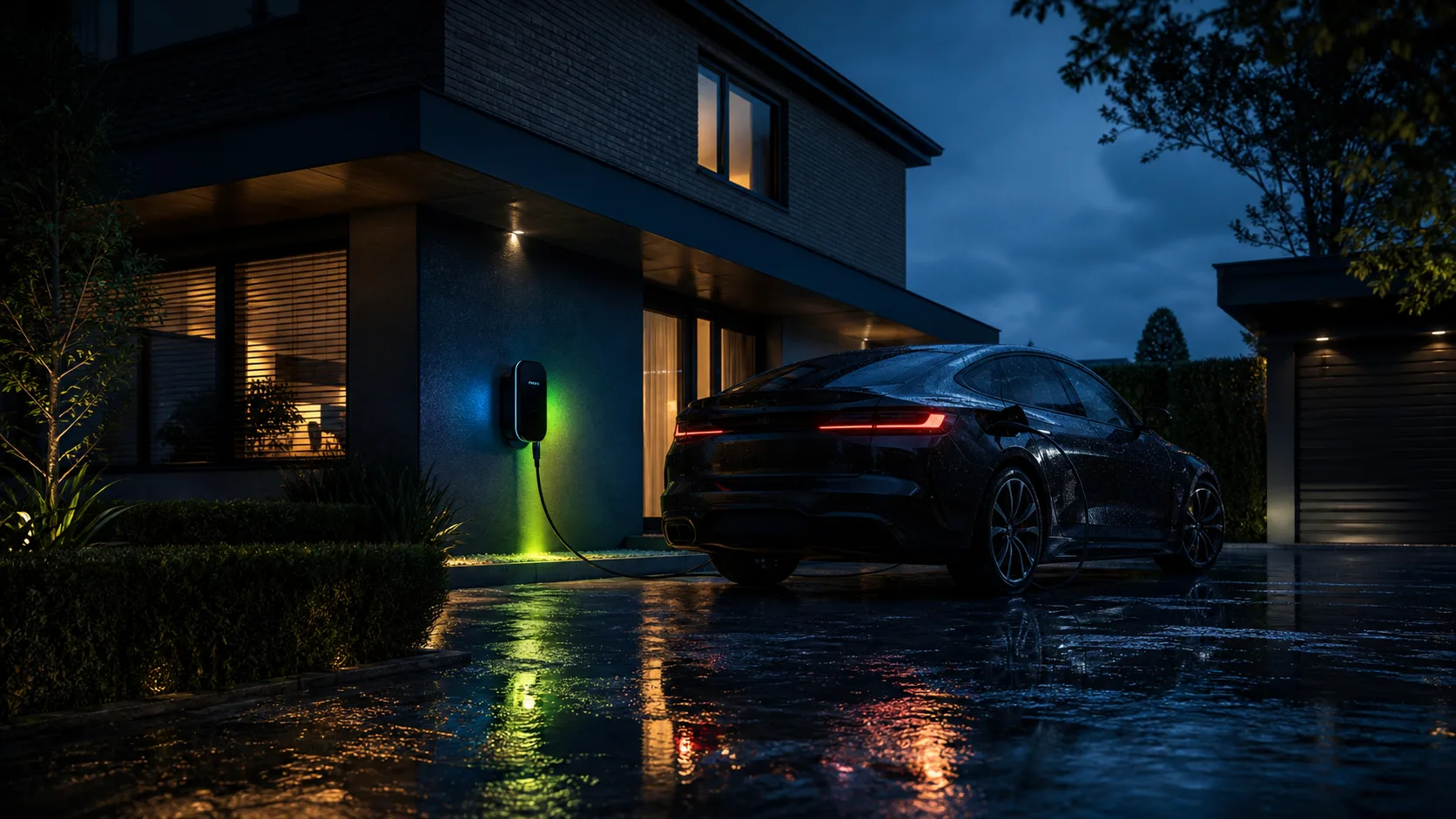
No off-street parking doesn't lock you out. The on-street provision route — through local-authority schemes and the chargepoint grant for renters/flats — can still cut the cost of getting charging where you live.
Roughly a third of UK households have no off-street parking, and for years that single fact was treated as a dead end for home charging: no driveway, no wallbox, no cheap overnight electricity. That is no longer the whole story. In 2026 there are two distinct routes for drivers without a private parking space — the EV chargepoint grant for people who rent or own a flat, and on-street provision delivered by your local authority — and used together they can get reliable, affordable charging to your front door without a driveway in sight.
This guide separates the two, because they are constantly confused. One is money toward a charger on your own property (a wall, a garden, a shared car park). The other is infrastructure in the public highway — a lamp-post socket or a channel across the pavement — that the council, not you, ultimately owns. Knowing which one fits your situation is what turns ‘I can’t charge at home’ into a booked installation.
Can you get an EV charger grant without a driveway?
Yes — the 2026 rules were specifically rewritten to put renters and flat owners in scope, and those are exactly the people who most often lack a driveway. The old Electric Vehicle Homecharge Scheme closed to owner-occupiers with private driveways precisely so the remaining budget could be steered toward households that the first wave of grants left behind: flats, rented homes, and properties that rely on the kerb.
The mechanics are simple. You don’t fill in a government form or wait for a cheque. An OZEV-approved installer checks your eligibility, fits the charger, and claims the grant on your behalf so it lands as a discount on your invoice rather than a refund you chase later. The headline figure for the 2026 chargepoint grant is up to £500 per socket, with separate, larger funding streams for landlords installing multiple units and for residential car parks. Always confirm the current cap on gov.uk before you book, as scheme details are updated periodically.
The catch for renters is consent: you need your landlord’s written permission to fit a charger to the property. For leaseholders in a block, you may also need freeholder or managing-agent sign-off, especially where the cable or unit touches communal space. None of this is unusual — installers handle it constantly — but it is worth starting the conversation before you book a survey.
How on-street EV charging actually works
On-street provision is the genuinely different route, and it’s the answer when there is no realistic way to put a charger on your own property — a tenement flat, a terrace that opens straight onto the pavement, a property with only kerbside parking. Here the chargepoint lives in or beside the public highway, which means the local authority leads, not you.
There are three common models. Lamp-post (or bollard) charging retrofits a socket into existing street-lighting columns — cheap to roll out because the power is already there, typically slow-to-fast AC suited to overnight top-ups. Dedicated on-street chargepoints are standalone units installed at the kerb under council schemes, often part-funded by central government’s Local EV Infrastructure (LEVI) programme. Cross-pavement channels are the newest and most driveway-like option: a narrow recessed gully is cut into the footway so you can run your own cable from the house to a car parked outside without it becoming a trip hazard — letting you charge on your own domestic tariff at the kerb.
The cross-pavement route is the one to watch if you have a usable wall or supply but only on-street parking, because it combines the public-highway permission you need with the cheap home electricity you want. It is the closest thing to a driveway install for a kerbside home, and it is increasingly the option councils approve because it shifts the running cost to the resident’s own meter.
Start with your local authority
Because the chargepoint sits in the public highway, your council is the gatekeeper for every on-street option. Search your local authority’s website for ‘EV charging’ or ‘residential chargepoint request’ — many now run an online form where you flag a street that needs provision or apply for a cross-pavement permit. Councils pool demand street by street, so registering interest genuinely moves the queue, and the more requests a road generates the sooner it tends to be scheduled.
Expect this route to be slower than a private install. A wallbox on your own wall can be fitted within the typical two-to-four-week lead time the home-charging providers quote; an on-street scheme runs to the council’s programme and can take months. The trade-off is that you pay little or nothing toward the kerbside infrastructure itself — the public funding (LEVI and operator investment) covers it — though you may pay a slightly higher per-kWh rate at a public on-street unit than you would on a cheap overnight home tariff.
What it costs, and how to sanity-check any quote
If your route is a grant-supported charger on your own property — the renter or flat-owner path — the relevant benchmark is the cost of a standard home install, less the grant. Our live UK cost index currently puts the average price of a standard 7kW home install at £1,087, drawn from real tracked prices that span roughly £775 at the low end to £1,404 at the high end. Subtract the grant where you qualify and your net outlay falls accordingly.
For market context, independent and provider sources cluster around that band: trade-directory site Checkatrade quotes a typical home install around £1,000; among the providers we track, Pod Point and British Gas list installs from £999 and Octopus Energy from £1,029; E.ON has publicly advertised installs from around £1,272; and drivers on Reddit’s UK EV communities frequently report a real-world floor near £999. Specialist retailer evec has promoted hardware-plus-grant deals as low as £449.99. Those are other organisations’ figures, cited so you can see where the market sits — not ChargeQuote’s own prices. Use our index average of £1,087 as the honest yardstick, and treat any quote far above it as a prompt to ask what’s driving the difference (a long cable run, a consumer-unit upgrade, communal-area works in a block).
Almost everyone installing at home, with or without a driveway, should fit a 7kW charger: it runs on a standard single-phase supply and fully refills any EV overnight. A 22kW unit needs a three-phase supply most UK homes don’t have, and our index now tracks real 22kW installs at an average of about £1,150 — only a little above 7kW, but pointless without three-phase power. For a kerbside or flat install, 7kW is the sensible default.
On the on-street side, the cost question flips: the kerbside hardware is largely funded for you, but you may not get rock-bottom overnight rates at a public unit. A cross-pavement channel sits in between — a one-off permit and channel-cutting fee, after which you charge on your own cheap home tariff.
Your next step
If you rent or own a flat, the fastest path is a grant-backed charger on your property: confirm landlord or freeholder consent, then line up an OZEV-approved fitter who can claim the grant for you. You can find an approved installer through our network and check the detailed eligibility rules on our on-street and no-driveway grant page. If your only option is genuinely the kerb, register interest with your council for on-street provision in parallel — the two routes aren’t mutually exclusive, and pursuing both is the surest way to be charging at home sooner.